

Blogs
Sewer Camera Accessories You Shouldn’t Skip
Mar
A sewer camera is only as effective as the setup surrounding it. That’s something new buyers often learn the hard way, they invest in a solid camera for inspection, head out to their first job, and quickly realize the camera alone doesn’t cut it. The cable snags without proper guidance. The head drags and catches in offset joints. They can’t locate a blockage underground without someone digging blind.
The right sewer camera accessories aren’t extras. They’re the difference between a clean, professional inspection and a frustrating, time-wasting ordeal that costs you credibility on the job site.
This guide covers the accessories every sewer camera operator should have on hand, what each one does, why it matters, and what to look for when you’re buying.
Why Sewer Camera Accessories Matter as Much as the Camera Itself
Think of your sewer camera the way you’d think of a vehicle. The engine is important, but without tires, brakes, and working lights, you’re not going anywhere safely. The same logic applies to pipeline inspection. Your camera for inspection is the engine. The accessories are everything that makes it functional in real-world field conditions.
Skipping key sewer camera accessories doesn’t just slow you down, it can damage your equipment. Running a camera head without the right pipe camera skid through a rough-bottomed line scrapes the housing. Operating without a sonde locator means you’re inspecting blind to depth and position. Letting batteries die mid-job because you didn’t carry a backup turns a quick drain inspection into an embarrassing callback.
Getting your accessory kit right from the start pays off fast.
Cable Reels: The Foundation of a Functional Sewer Camera Setup

The cable reel might be the least glamorous sewer camera accessory, but it’s arguably the most important. A well-designed reel protects your cable investment, makes the camera for inspection easier to deploy and retrieve, and prevents the kinking and tangling that shortens cable life dramatically.
When your sewer camera cable gets kinked, especially close to the camera head, image quality degrades, signal transmission weakens, and the structural integrity of the cable is compromised. A good reel keeps tension consistent during deployment and resets the cable cleanly on retrieval.
What to Look for in a Sewer Camera Reel
- Smooth bearing system: The reel should spin freely with minimal resistance. Stiff or jerky reels put unnecessary strain on the cable and make long runs physically exhausting.
- Cable capacity: Match the reel to the cable length your sewer camera uses. A reel that’s too small forces uneven winding; too large and the cable sits loosely and shifts during transport.
- Integrated counter: A built-in cable counter tells you exactly how far your camera for inspection has traveled into the pipe, essential for accurate reporting and locating problem areas.
- Slip ring connection: This allows the reel to spin freely without twisting the signal cable. It’s a critical feature that cheaper reels often skip, and it’s the first thing you’ll miss when it’s absent.
- Portability and mounting: Consider how the reel attaches to your cart or van. A stable mount prevents the reel from shifting during transport, which protects both the reel and the sewer camera cable wound on it.
Pipe Camera Skids: Protecting Your Camera Head in Every Line

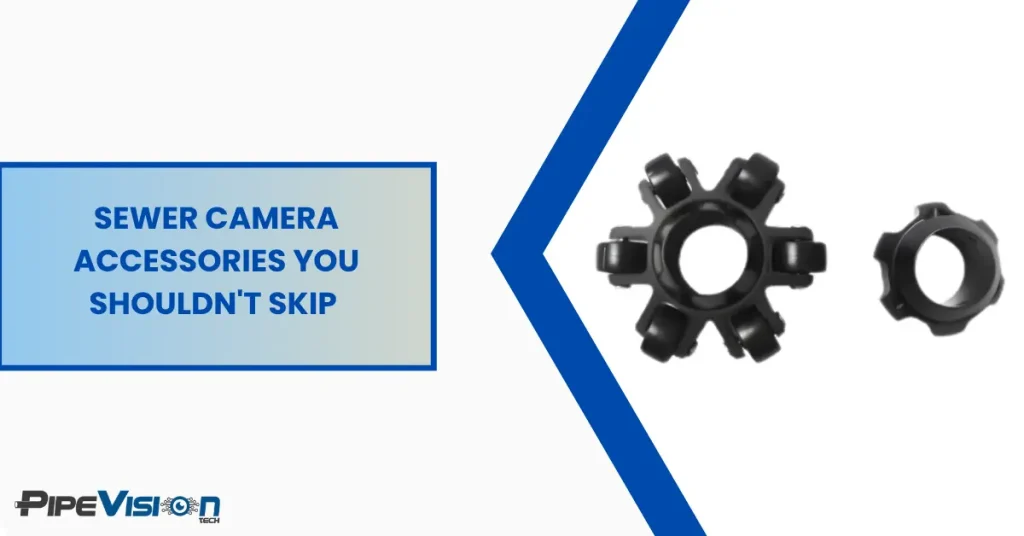
If there’s one sewer camera accessory that’s consistently underestimated, it’s the pipe camera skid. A skid is a small frame, typically made from stainless steel or a durable polymer, that attaches around the camera head and holds it centered in the pipe. It sounds simple. The impact is significant.
Running a sewer camera without the right pipe camera skid causes the camera head to drag along the bottom of the pipe. In PVC or smooth-bore HDPE, you might get away with it for a while. In clay tile, corrugated metal, or older cast iron with rough internal surfaces, the camera housing gets ground down. Camera heads are expensive — often the most expensive single component on a sewer camera system. Protecting them with the right pipe camera skid is one of the most cost-effective decisions you can make.
Choosing the Right Pipe Camera Skid for the Job
Pipe camera skids come in multiple sizes to match different pipe diameters. Using the wrong size defeats the purpose, too small and the skid won’t center the camera, too large and it won’t fit through tight sections or transitions.
- Match skid size to pipe diameter: Most sewer camera skid sets include multiple sizes for common pipe ranges, typically 2″ through 6″ for smaller residential cameras for inspection, up to 12″+ for larger commercial systems.
- Material matters: Stainless steel skids are durable and handle abrasive pipe interiors well. Polymer skids are lighter and gentler on fragile older pipe materials.
- Low-profile design: For heavily offset or root-infiltrated lines, a lower-profile pipe camera skid gives you better mobility through tight transitions.
- Buy a full skid set: Jobs vary. Having a complete range of pipe camera skid sizes means you’re never caught under-equipped on a job site.
Some professional sewer camera operators carry a dedicated skid kit in their vehicle at all times. Given that a replacement camera head can cost hundreds to thousands of dollars, a $50–$150 pipe camera skid set is an easy investment to justify.
Sonde Locators: Finding Exactly Where Problems Are Underground

A sonde locator: sometimes called a sonde transmitter and receiver, is one of the most practically powerful sewer camera accessories available. It solves a fundamental problem: you can see what’s inside the pipe, but without a locator, you have no idea precisely where underground that problem is.
Here’s how it works. A sonde (a small electronic transmitter) is either built into the sewer camera head or attached to the cable near it. As the camera for inspection moves through the pipe, the sonde emits a signal. Above ground, a handheld receiver, the locator detects that signal and shows you exactly where the camera head is, including depth.
For excavation work, this is invaluable. Instead of guessing where to dig, or digging a trench hoping to intercept the problem area, crews can mark the exact surface location of a blockage, collapse, or root intrusion. That saves time, reduces excavation costs, and makes your sewer camera service dramatically more useful to clients.
What to Know Before Buying a Sonde Locator
- Frequency compatibility: Sondes operate at specific frequencies — 512 Hz and 33 kHz are the most common. Your sonde locator (receiver) must be compatible with the frequency your sewer camera’s sonde transmits. Always verify compatibility before purchasing.
- Detection depth: Most sonde locators perform reliably to around 3–5 meters. For deeper systems, look for locators rated for greater depth or consider a higher-powered sonde.
- Integrated vs. add-on sonde: Some sewer cameras have a sonde built directly into the camera head. Others require a separate sonde accessory clipped onto the cable. Know your setup before buying a locator.
- Ease of use: A good sonde locator should be readable in bright sunlight, easy to interpret while walking, and manageable with one hand. Overcomplicated interfaces slow down what should be a quick locate-and-mark process.
- Battery life: You’ll often be using the locator for extended periods on site. Choose a sonde locator with solid battery runtime and a battery level indicator so you’re never caught off-guard.
For any sewer camera operation that involves excavation decisions, a sonde locator isn’t optional, it’s a core tool. Clients expect precision. A locator delivers it.
Batteries and Power Management: The Overlooked Sewer Camera Accessories
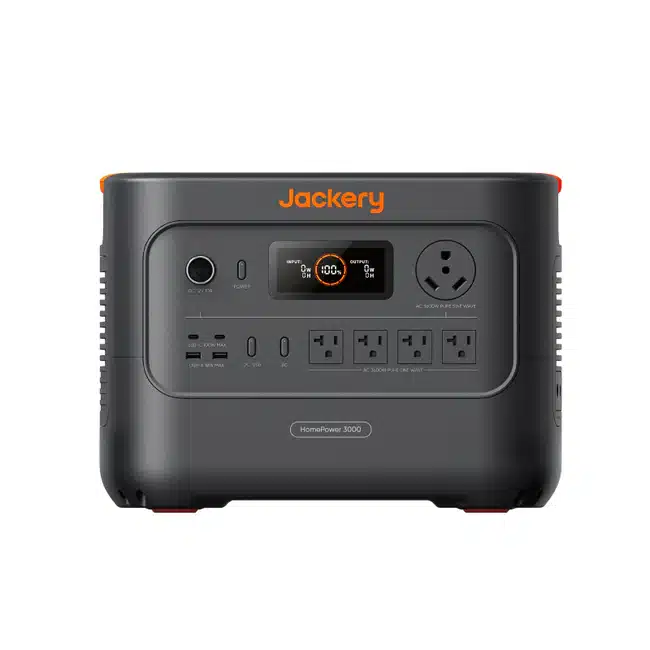
Nothing is more frustrating than a camera for inspection that dies in the middle of a job. Batteries and power management might be the least exciting category of sewer camera accessories, but they’re among the most operationally critical.
Modern sewer cameras are power-hungry systems. The LED lighting array, the transmitter, the display monitor, and the recording system all draw power simultaneously. Depending on the system, a single battery pack may last anywhere from two to eight hours under active use. On a busy inspection day with multiple jobs, that may not be enough.
Smart Battery Strategy for Sewer Camera Operators
- Always carry a spare: The most basic rule of sewer camera power management. A second fully charged battery pack means a dead battery never ends a workday early.
- Use OEM or quality-matched batteries: Generic replacement batteries for sewer cameras often don’t deliver the rated capacity and can cause charging issues or intermittent power drops during inspections. Stick with manufacturer-approved packs where possible.
- Track battery cycles: Lithium batteries degrade over charge cycles. Know roughly how many cycles your battery packs have accumulated, and replace them proactively before they start failing in the field.
- Consider a vehicle charging setup: Many sewer camera operators wire a dedicated charging station into their work vehicle so batteries are replenishing between jobs automatically, without any extra steps.
- Dim the monitor when possible: On longer inspections with straightforward lines, reducing monitor brightness is one of the simplest ways to extend battery life without affecting inspection quality.
Other Sewer Camera Accessories Worth Having
Beyond reels, pipe camera skids, sonde locators, and batteries, there are several other sewer camera accessories that experienced operators keep in regular rotation.
Replacement Camera Heads
Having a backup camera head for your sewer camera system isn’t a luxury for high-volume operators, it’s standard practice. Camera heads take the most direct punishment during inspection work, and having a spare means a damaged head doesn’t sideline your entire operation while you wait for a repair.
Protective Cases and Transport Bags
A quality camera for inspection is a significant investment. Protecting it during transport with a purpose-built case, hard shell for air transport, padded soft case for van use, extends equipment life and keeps all your sewer camera accessories organized in one place.
Cleaning Supplies and Cable Lubricant
Sewer work is inherently dirty. After every inspection, properly cleaning the sewer camera cable, camera head, and pipe camera skid components prevents grease and debris from hardening on surfaces, corroding connectors, or carrying contamination between job sites. Cable lubricant also reduces friction during deployment, especially in longer or more complex lines.
Reporting and Recording Equipment
Many sewer camera systems support USB drives, SD cards, or DVR attachments for on-site recording. If your camera for inspection will be used for formal inspections, home sales, municipal work, insurance claims, having clean, timestamped video documentation is essential. Make sure you have the right media and adapters in your kit.
Building Your Sewer Camera Accessories Kit: Where to Start
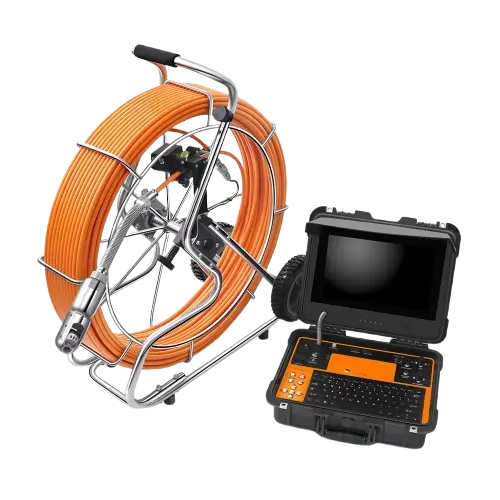
If you’re putting together your kit for the first time, here’s a practical starting point based on what experienced operators actually use on a regular basis:
- A quality cable reel with slip ring and integrated counter – matched to your sewer camera’s cable length.
- A complete pipe camera skid set – covering the pipe diameter range you typically inspect.
- A compatible sonde locator – verified for frequency match with your camera’s built-in or accessory sonde.
- Two fully charged battery packs – always one on the camera, one charging or in reserve.
- Cleaning kit and cable lubricant – for daily maintenance and job-site cleanup.
- Recording media – USB or SD card for documentation.
As your sewer camera operation grows, you can expand from there, additional pipe camera skid sizes for new pipe types, a higher-powered sonde locator for deeper systems, or a second complete camera for inspection setup to run parallel jobs.
Don't Let the Wrong Accessories Limit a Great Sewer Camera
The sewer camera market has come a long way. Today’s systems deliver exceptional image quality, long cable runs, and reliable performance, but only when they’re properly equipped. Skipping the right pipe camera skid costs you camera heads. Operating without a sonde locator costs you credibility on jobs that require excavation precision. Running low on battery power mid-inspection costs you time, professionalism, and sometimes the inspection itself.
The good news is that quality sewer camera accessories don’t have to break the budget. A well-chosen kit: reel, pipe camera skid set, sonde locator, and backup batteries, typically costs a fraction of the camera itself. And in the field, that kit pays for itself on the very first job it saves.
Browse our full selection of sewer camera accessories, including pipe camera skids, sonde locators, reels, and battery packs, everything you need to put your camera for inspection to work at full potential.
